# element-docker-demo
element-docker-demo is a minimal example of how to rapidly stand up a Matrix 2.0 stack on macOS or Linux using Docker,
featuring:
* Element Web
* Element Call
* Synapse
* Matrix Authentication Service
* LiveKit
* Postgres
* nginx + letsencrypt / mkcert for TLS.
This is **not** intended for serious production usage, but instead as a tool for curious sysadmins to easily experiment
with Matrix 2.0 in a simple docker compose environment. As of Nov 2024, it's considered beta.
In particular, this has:
* No support, security or maintenance guarantees whatsoever
* No high availability, horizontal scalability, elastic scaling, clustering, backup etc.
* No admin interface
* No monitoring
* No fancy config management (eg ansible), just env vars and templates
* No fancy secret management (stored in plaintext on disk)
* No UDP traffic or TURN for LiveKit (all traffic is tunnelled over TCP for simplicity)
* No push server, integration manager, integrations, or identity lookup server
For production-grade Matrix from Element, please see https://element.io/server-suite (ESS).
## To run
1. Install [Docker Compose](https://docs.docker.com/compose/install/).
2. If you're running on your local workstation, then [install mkcert](https://github.com/FiloSottile/mkcert#installation) to manage TLS.
Then:
```
./setup.sh
# Point DNS for *.domain at your docker host,
# Or if running on localhost with mkcert:
# source .env; sudo sh -c "echo 127.0.0.1 $DOMAINS >> /etc/hosts"
docker compose up
# go to https://element on your domain.
```

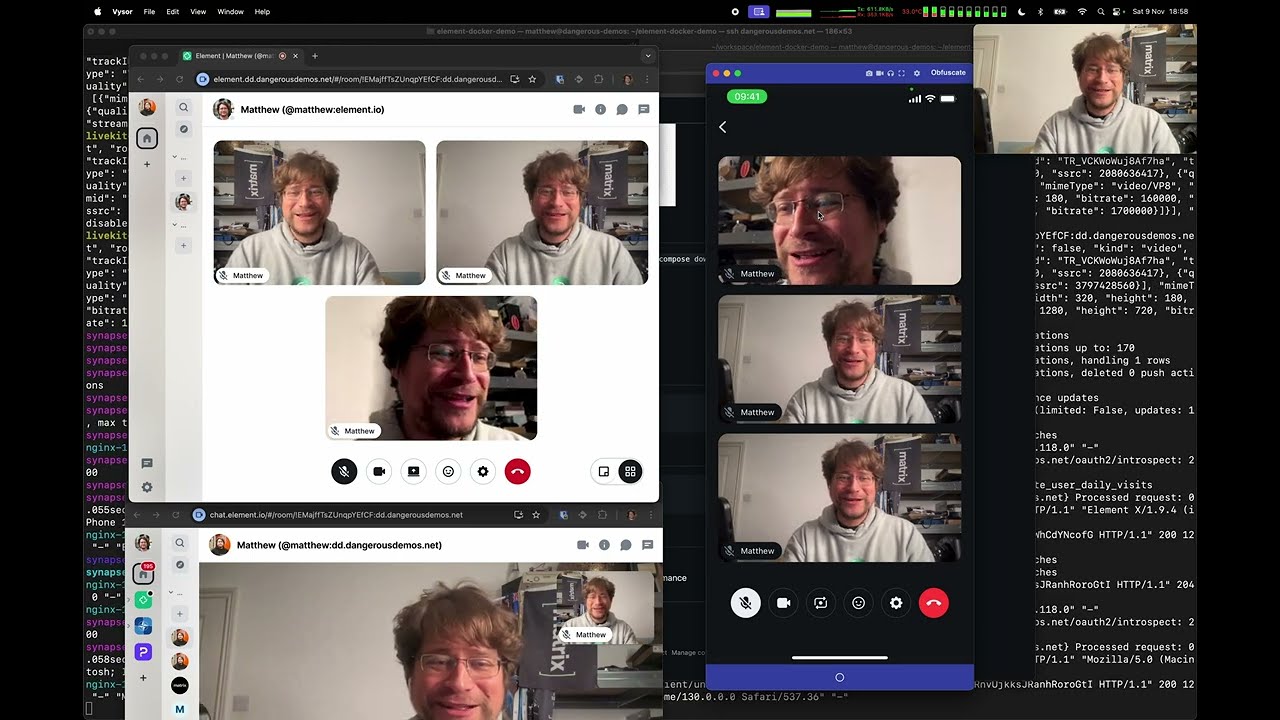
Watch the full video:
For more info, see https://element.io/blog/experimenting-with-matrix-2-0-using-element-docker-demo/
## To configure
Check the .env file, or customise the templates in `/data-templates` and then `docker compose down && docker compose up -d`.
In particular, you may wish to:
* Point at your own SMTP server rather than mailhog
* Use your own reverse proxy rather than the provided nginx
* Use your own database cluster
Container data gets stored in `./data`, and secrets in `./secrets`.
N.B. that config files in `./data` will get overwritten by the templates from `./data-template` every time the cluster
is launched.
## To admin
```bash
# To upgrade
docker compose pull
```
```bash
# To register a user
docker compose exec mas mas-cli -c /data/config.yaml manage register-user
```
## Diagnostics
```bash
# check that OIDC is working - useful for debugging TLS problems
docker compose exec mas mas-cli -c /data/config.yaml doctor
````
## Other resources
* This was originally based on https://github.com/element-hq/synapse/tree/master/contrib/docker_compose_workers
* Other guides for MAS and Element Call from Sebastian Späth at:
* https://sspaeth.de/2024/08/matrix-server-with-nextcloud-login/
* https://sspaeth.de/2024/11/sfu/
* https://cyberhost.uk/element-matrix-setup/ is a good Matrix 1.0 docker-compose guide too
## Todo
* [ ] pop up https://element in your browser once synapse has started up successfully for the first time, perhaps
* [ ] test $VOLUME_PATH (or remove it)
* [ ] swap nginx for caddy or traefik to simplify Letsencrypt
* [ ] set up livekit TURN (tcp & udp port 443) for better firewall traversal and voip performance